

Push-Back Pallet Racking
In the fast-moving Australian logistics sector, maximising every cubic metre of your facility is the difference between scaling up and getting stuck. Push-back pallet racking represents a significant leap in warehouse design, offering a high-density alternative that doesn't compromise operational speed. By utilising a dynamic, nested push-back carriage system on inclined rails, this solution allows you to store pallets up to six deep, effectively reclaiming the warehouse space typically lost to redundant forklift aisles.
At One Stop Pallet Racking (OSPR), we specialise in engineering push-back racking systems that offer a smarter middle ground between traditional selective pallet racking, drive-in racking, and other storage methods. Our layouts are designed to condense your inventory while ensuring your team can load and pick with far greater agility than standard "static" high-density systems allow.

Achieving High Density Without Sacrificing Selectivity
Each lane operates independently on its own set of heavy-duty rails, every level and every lane can hold a different product line.
This creates a high-density environment with significantly better product selectivity. It is the ideal choice for Australian businesses that handle different products on pallets but still require direct access to a broad range of inventory. Our design team works with you to optimise the configuration, and the slight incline needed, ensuring your specific pallets roll forward safely and reliably every time a load is retrieved.
Comparing Australian Warehouse Storage Systems
To help you determine which system best fits your SKU profile and operational requirements, we have compared the primary racking types utilised across Australia:
The Strategic Benefits of Push Back Pallet Racking
Australian warehouse managers choose push back systems when they need to increase pallet counts without the massive overhead of moving to a larger facility.
- Maximised Storage Footprint: Convert your current aisle space into productive, revenue-generating storage positions.
- Reduced Forklift Travel: Because all loading and unloading occurs at the aisle face, your drivers spend less time navigating the warehouse and more time moving stock.
- Enhanced Safety & Lower Maintenance: Forklifts stay in the aisles and never enter the rack structure. This minimises accidental impacts and significantly reduces long-term repair costs for uprights and frames.
- Standard Fleet Compatibility: Unlike double-deep systems that require specialised reach attachments, most push back systems can be serviced by your existing counterbalance or reach truck fleet.

Engineered for Absolute Safety
In high-density environments, structural precision is non-negotiable. At OSPR, every push-back installation is engineered to the highest standards,. We use precision-rolled steel designed to handle the dynamic forces of "pushing" loads without stressing the rack's integrity.
We calibrate the rail incline to ensure a walking-pace "glide" for your pallets, preventing abrupt movements or "runaway" loads. Every project is handed over with mandatory Safe Working Load (SWL) ensuring your facility’s safety and efficiency.

Specialised Accessories for Dynamic Storage Capacity
To safeguard your investment and your team, we offer a suite of pallet racking accessories designed for the high-frequency demands of a push-back system.
- Heavy-Duty Column Guards: Reinforced steel shielding for the entry uprights, the most critical points in high-traffic loading zones.
- Full-Surface Carts: Optional mesh that allows for the safe storage of non-standard or plastic pallets that might otherwise be ineffective to use with traditional rails.
The One-Stop "Turnkey" Process
Transforming your warehouse layout should be a seamless transition. Our "One Stop" service model handles every detail, allowing you to focus on your core business while we optimise your storage.
Our process begins with a CAD design phase, providing a site-specific layout that accounts for your forklift’s operational requirements. We manage the entire supply chain through our national network, ensuring high-quality components arrive on-site. Our professional installation teams prioritise safety and minimal operational disruption.

Take Advantage of High-Density Storage Solutions Today
Maximising your warehouse potential starts with a layout designed for density, speed, and safety. Our expert team is ready to help you design a push-back pallet racking system that improves your bottom line.
To discuss your project, get expert advice, or receive a quotation, please contact us on 0410 894 157 or fill out our contact form. One of our specialists will get back to you shortly to discuss your requirements.
Push-back racking may not be suitable for operations with a very high number of pallet sizes and weights, poor pallet condition, or strict FIFO requirements. Because push-back operates on a LIFO basis, it is best suited to operations with controlled stock rotation and consistent pallet quality.
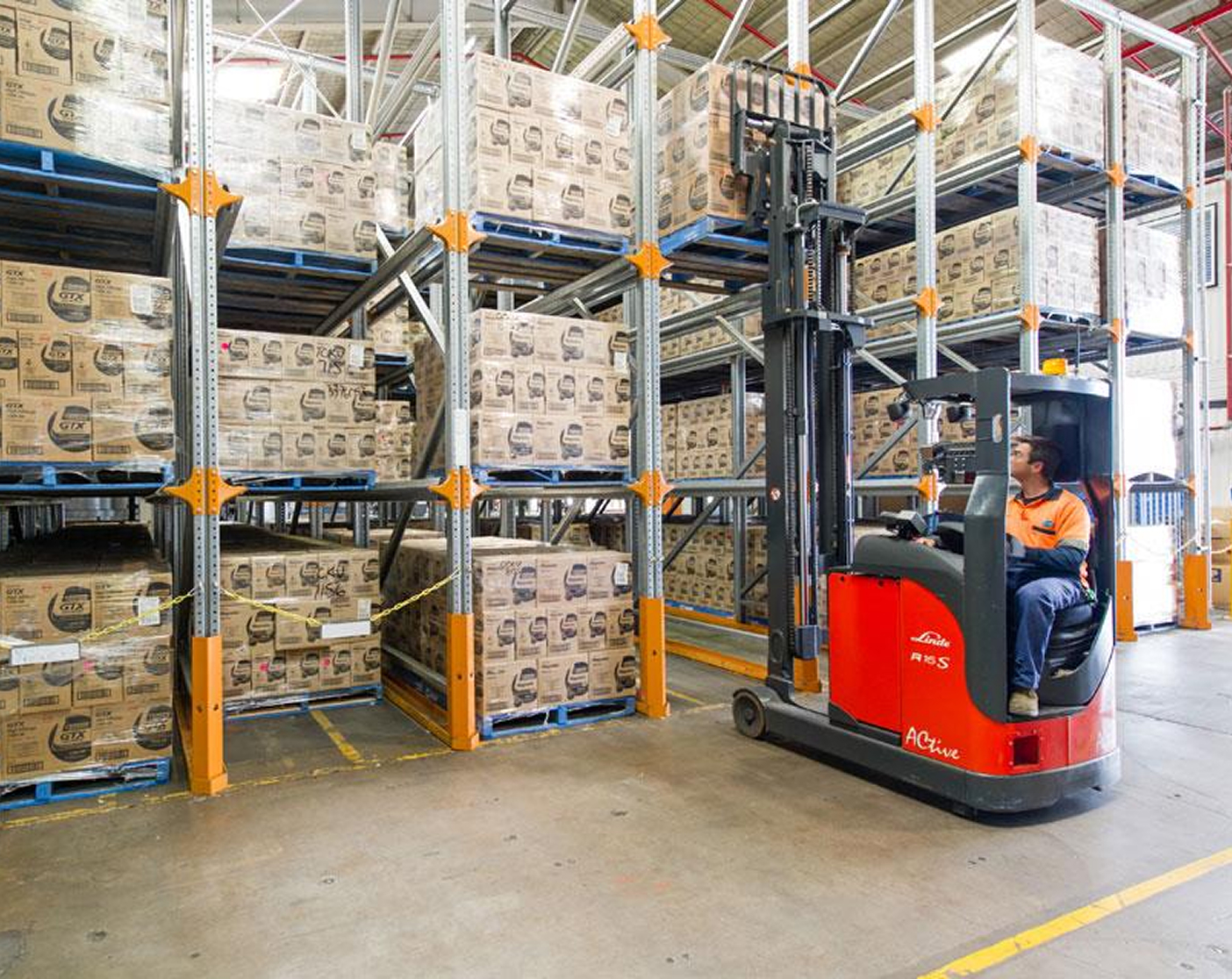
Forklifts operate only at the face of the lane, eliminating the need to drive into racking aisles. This reduces travel time and minimises the risk of racking impact. However, operators must be trained to place pallets squarely onto the carts to ensure smooth engagement and safe pallet movement.
Push-back systems work best when pallet footprints within a lane are consistent. Minor variations can be accommodated, but mixing significantly different pallet sizes in the same lane can affect stability and tracking on the carts. Where pallet sizes vary, we usually allocate separate lanes or design the system around the largest pallet size.
The slope in a push-back system is typically engineered at a slight 2 to 3-degree pitch. While this incline is essential for gravity to glide the pallets forward, it does mean the pallets sit at a very slight angle. For exceptionally tall or unstable loads, our engineers factor this "lean" into the vertical space (aperture) of the beam levels. We ensure there is enough "headroom" so that as the pallet moves, it never makes contact with the system above.
Yes, but it requires careful planning. We usually design the system based on your heaviest anticipated pallet to ensure the system supports the load. If weights vary significantly, we can adjust the rail pitch to ensure that even lighter pallets glide forward reliably when the front load is removed.