

Key Takeaways
- Damage rarely announces itself. A forklift knock that looks like minor damage at the time can leave pallet racking that keeps carrying full loads for weeks or months before it fails, often without warning.
- Five warning signs account for most structural failures. Bent or buckled uprights, frames that are out of plumb, cracked or corroded welds and connections, missing safety clips, and damaged base plates or floor anchors are where collapse risk concentrates.
- What you do in the five minutes after spotting pallet racking damage matters as much as spotting it. Isolating the bay, reporting it, and getting it assessed by a competent person is what actually turns a warning sign into a prevented incident, rather than a missed one.
Pallet racking is one of the hardest-working structures in any warehouse operation. It holds tonnes of stock several metres above the heads of the people working underneath it, and it absorbs knocks, scrapes, and near-misses from forklifts as a matter of routine. Most of the time it shrugs this off without complaint, which is exactly why damaged pallet racking is so easy to walk past without a second look.
That is the danger. A racking collapse is one of the most serious incidents a warehouse can experience, and in almost every case, there were visible warning signs beforehand that simply weren't recognised, reported, or acted on. Learning what damage actually looks like, and where to expect it, is one of the simplest and most effective things a warehouse team can do to prevent it.
At One Stop Pallet Racking, we are a family-owned Australian business supplying, installing, and inspecting racking systems for warehouses across Sydney, Melbourne, Brisbane, Perth, Adelaide, and regional Australia. This guide walks through the damage every staff member should be able to recognise, so the gap between your annual formal inspection under AS 4084:2023 doesn't become the gap where a problem goes unnoticed.
Why Damaged Pallet Racking Is So Easy to Overlook
Steel racking looks permanent. It is bolted to the floor, at load capacity, and part of the daily backdrop of a warehouse, so a dent or a scrape rarely feels urgent. Staff walk past the same bay every day and stop truly seeing it, and a mark that has been there for months starts to look like it simply belongs.
The physics work against you too. Steel can absorb a surprising amount of impact before it visibly deforms, and racking is engineered with a margin of safety built in. That margin is exactly what allows damaged racking to keep functioning, sometimes for a long time, right up until it doesn't. Each additional knock erodes that margin a little further, and there is rarely a clear moment where "fine" tips into "dangerous." It is a slow accumulation that ends abruptly.
Add in the pace of a working warehouse, where staff are focused on picking, dispatching, and moving stock rather than scanning the structural integrity of what's above them, and it becomes clear why damage is so often missed until a formal inspection finds it, or worse, until it fails.
Five Warning Signs Every Warehouse Team Should Know
You don't need to be an engineer to spot the difference between racking that is sound and racking that needs urgent attention. These five signs cover the large majority of the structural damage that leads to collapse.
Bent or Buckled Uprights
The uprights are the vertical columns that carry the entire weight of the system down to the floor, which makes them the single most safety-critical structural component to check. Look for any visible curve, dent, or kink along the length of an upright, particularly a sideways bow (bowing outward from the frame) that wasn't there before. Even a bend of a few centimetres can significantly reduce how much load an upright can safely carry, because it changes how the steel handles compression.
Frames That Are Out of Plumb (Leaning Racking)
A racking frame should stand perfectly vertical. If a run of racking appears to lean, either along the aisle or across it, that is a serious structural warning sign rather than a cosmetic one. You can often spot it by eye from the end of an aisle, comparing one frame against the next, or by checking whether a plumb line or spirit level held against an upright shows any visible gap. Leaning racking is frequently the first visible sign of a much larger problem with the frame or its anchoring.
Cracked, Deformed, or Rusted Welds and Connections
Every point where a beam meets an upright, or where bracing connects to a frame, relies on a weld or connector to transfer load safely. Look closely at these joints for hairline cracks, visible gaps opening up, or welds that look chewed or deformed. Surface rust that has progressed to flaking or pitting at a weld point is also a red flag, because corrosion weakens exactly the point the structure depends on most.
Safety Clips Missing or Dislodged
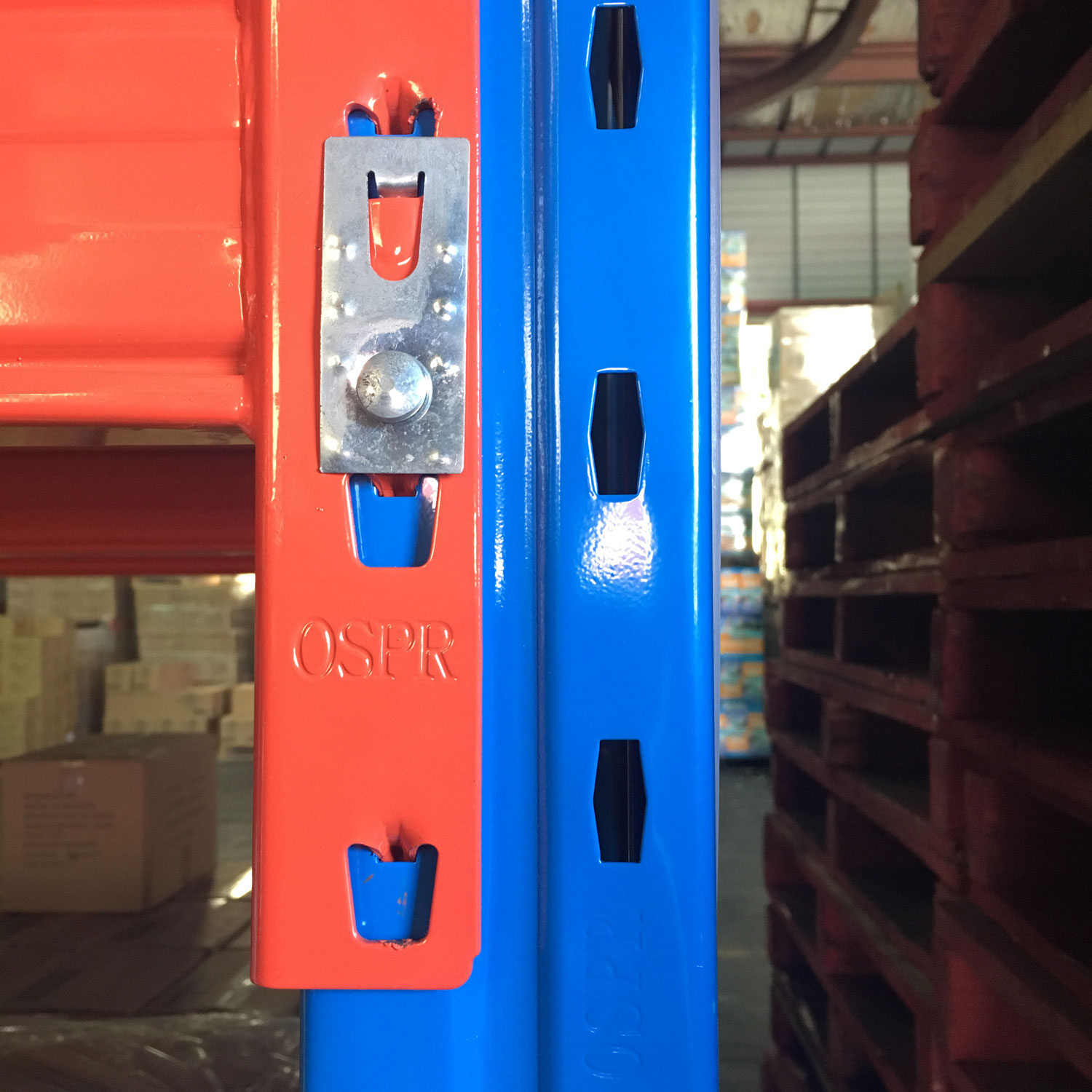
Safety clips lock beams onto the connector plates on each upright, stopping a beam from lifting or sliding free during normal use or a forklift impact. They are small, they are the easiest component to overlook, and they are also one of the most common findings in a formal inspection. Walk the length of a bay and check that every beam has its clip in place and properly seated, not just resting loosely or missing altogether.
Damaged Base Plates and Floor Anchors
The base plate and its floor anchors are what actually hold the entire structure down. Damage here is easy to miss because it sits low and close to the floor, often behind stock or in a dim corner. Look for a base plate that has lifted, bent, or pulled away from the concrete, anchor bolts that are visibly loose, sheared, or missing, or cracking in the concrete slab immediately around the fixing. Any movement at this point compromises the stability of everything above it.
Where Damage Concentrates in Your Warehouse
Damage is not spread evenly through a warehouse. It clusters in a handful of predictable places, and knowing where to look makes spotting it far quicker.
The lower section of every upright, roughly the bottom 400mm, takes the overwhelming majority of forklift impacts, which is precisely why AS 4084:2023 mandates upright protectors of at least that height on end frames in trafficable areas. Row ends facing an aisle or a thoroughfare are struck more often than mid-row bays simply because more traffic passes them.
Aisle intersections and corners, where forklifts turn and visibility is reduced, see a disproportionate share of impacts. In drive-in systems, where forklifts operate inside the racking structure itself rather than alongside it, damage risk extends further into the bay and warrants a closer, more frequent look.
What Typically Causes the Damage
Forklift impact is by far the most common cause, whether from a misjudged turn, a loaded pallet clipping an upright, or a reversing manoeuvre in a tight aisle. Overloading is another frequent culprit, where a beam or bay carries more weight than its rated load limit, placing ongoing stress on components that were never designed to bear it.
Incorrect pallet placement, such as a pallet overhanging the beam face or sitting unevenly, concentrates load in places the system wasn't designed to handle. Corrosion, particularly in coastal, cold storage, or high-humidity environments, gradually weakens steel from the inside even when the surface looks intact. And in some cases, damage traces back to the incorrect installation itself, where components weren't properly levelled, fixed, or specified for the load in the first place.
What to Do the Moment You Spot Damage
Finding damage is only useful if it changes what happens next. If you spot any of the warning signs above, a few simple actions make the difference between a near miss and an incident.
Stop loading the affected bay immediately, and if the damage looks significant, offload it. Never attempt to straighten a bent upright or force a damaged component back into place yourself, even if it looks like a quick fix. Steel that has already deformed has lost strength at that point, and bending it back does not restore it, it can make a bent component more likely to fail under load.
Cordon off or tag the area clearly so other staff know not to use it, and report it through your maintenance process with a photo, the location, and a brief description. From there, get it assessed by a competent person, who will classify the severity and confirm what needs to happen before the bay goes back into service.
How One Stop Pallet Racking Can Help
As a family-owned Australian business, we design, supply, install, and inspect pallet racking systems nationwide, backed by the buying power of a national supplier and the response times of a local team. If your staff have flagged a damaged pallet racking system, our inspection team can assess it against AS 4084:2023, tell you exactly what needs repair or replacement, and source genuine, load-rated components to match your existing system, so a damaged bay is back in safe service as quickly as possible.
We also help warehouse teams get better at spotting damage in the first place, with practical guidance your staff can apply on the floor between formal inspections. Whether it's one bay in a single warehouse or a national fleet of sites, we approach it the same way: assess it properly, fix it properly, and give you clear documentation to show for it.
Spotted something that doesn't look right on your racking? Give us a call on 0410 894 157, or request a quote online today.
Damaged Pallet Racking FAQs
If a forklift operator damages the racking, who is actually liable, the driver or the business?
Under Australian WHS law, the legal duty to provide a safe workplace sits with the business (the person conducting a business or undertaking), not the individual driver. That means the business is responsible for having a safe system of work in place, including training, reporting processes, and timely repair of known damage, regardless of who was behind the wheel at the time. An individual driver may face internal consequences depending on the circumstances, but regulatory liability for an unsafe racking system rests with the employer.
Do I need to clear the whole aisle, or just the bay where I found the damage?
In most cases, only the affected bay needs to be offloaded and isolated. However, because bracing and connections can tie neighbouring bays together structurally, a competent person may recommend checking the bays immediately either side, particularly if the damage involves a shared frame, brace, or connection point. When in doubt, treat the wider area as off-limits until an assessment confirms the extent of the damage.
How do I get staff to actually report damage instead of walking past it?
The biggest barrier is usually fear of blame rather than a lack of awareness. A simple, no-blame reporting process, such as a photo sent to a shared inbox or a quick entry in a maintenance log, removes the friction that stops people from speaking up. Keeping a visible supply of tags or barrier tape near high-traffic zones also makes it easy for staff to isolate a damaged bay on the spot, rather than leaving it until someone gets around to it later.
Does light surface rust always mean a component needs to be replaced?
Light surface rust that hasn't caused pitting, flaking, or any loss of the steel's cross-section can often be monitored rather than replaced immediately, particularly on components away from welds and connection points. The risk is that surface rust can mask more serious corrosion or hide impact damage underneath it, so it's worth a closer look rather than a quick dismissal. In coastal, cold storage, or high-humidity sites where corrosion progresses faster, it's worth checking these components more frequently, and galvanised finishes are worth specifying for any new racking in those environments.